

Court decision strengthens Canada’s plan to transition net-pen fish farms from B.C. waters by 2029
EcoJustice: January 29, 2026, the Federal Court of Appeal upheld the federal government’s 2023 decision to not renew licenses for 15 open-net salmon farms in British Columbia’s Discovery Islands
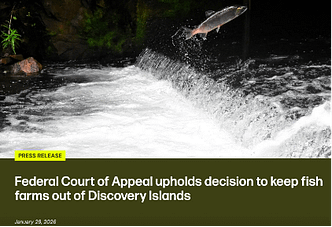
BREAKING: The Federal Court of Appeal has upheld the government’s decision to keep open-net pen fish farms out of the Discovery Islands. This is a MAJOR victory for pacific wild salmon and the communities that depend on them.
The ruling affirms the Minister of Fisheries and Oceans’ authority to take a precautionary approach when wild fish face serious threats.
This case had Ecojustice representing the @davidsuzukifdn, @georgiastraitbc, @living_oceans, @watershedwatchbc, and Alexandra Morton — who have all fought for this outcome for nearly five years.
This decision strengthens Canada’s path to end open-net fish farming in B.C. by 2029, giving wild salmon a fighting chance to recover in the face of pollution, overfishing, and disease.
Union of B.C. Indian Chiefs
News Release
January 30, 2026
(excerpts)
Federal Court of Appeal Upholds Discovery Islands Fish Farm Decision: A Victory for Wild Salmon, Indigenous Rights, and the Precautionary Principle
(xʷməθkʷəy̓əm (Musqueam), Sḵwx̱wú7mesh (Squamish) and səlilwətaɬ (Tsleil Waututh)/ Vancouver, B.C. – January 30, 2026) The Union of B.C. Indian Chiefs (UBCIC) welcomes the decision of the Federal Court of Appeal to dismiss the appeal brought by Mowi Canada West Inc. and other salmon farming companies challenging the federal Minister of Fisheries’ decision to decline renewal of aquaculture licenses in the Discovery Islands.
This decision follows the June 7, 2024 ruling of the Federal Court which also upheld the Minister’s decision. Together, these rulings confirm that the Minister acted reasonably, met the duty to consult, and was justified in applying a highly precautionary approach in an area critical to wild salmon and to the rights and livelihoods of First Nations.
For UBCIC, this outcome reflects years of consistent advocacy by First Nations leadership to protect wild salmon, uphold our inherent and constitutionally protected title and rights, and transition away from open net-pen aquaculture.
Grand Chief Stewart Phillip, UBCIC President, stated, “This decision is a profound affirmation that the protection of wild salmon, Indigenous rights, and the precautionary principle must come before corporate interests. The courts have now twice confirmed that the Minister was right to reject the advice that would have kept these farms in place. This is exactly what First Nations have been saying for decades, that open net-pen fish farms pose unacceptable risks to migrating wild salmon and to our inherent responsibilities to protect them.”…
Chief Dalton Silver, UBCIC political lead on fisheries, stated “This case has never been just about the Discovery Islands. It is about the migratory routes of wild salmon that connect our Nations from the coast to the interior. The Court’s decision recognizes that protecting this corridor is essential to the survival of wild salmon and to the cultures, food systems, and laws of our peoples. This is a critical step forward in the fish farm transition process.”
UBCIC is calling on Fisheries and Oceans Canada to now apply the same precautionary approach confirmed by the courts to the rest of the coast as the federal government proceeds with its coast-wide open net-pen transition planning.
https://www.ubcic.bc.ca/federal_court_of_appeal_upholds_discovery_islands_fish_farm_decision
Summary: In short, we can understand an explicit legal and policy connection between the Federal Court of Appeal decision and Canada’s plan to transition salmon net-pens out of B.C.’s waters by 2029:
By upholding the ban on Discovery Islands salmon farms and confirming the Minister’s authority to refuse licences based on precautionary, conservation-based science, this legal victory reinforces the federal mandate to phase out open-net pens across B.C. by 2029.
Key connections include:
-
Precedent for 2029: The court confirmed that Fisheries Ministers can refuse licence renewals to protect wild salmon, affirming the regulatory authority required to execute the 2029, five-year transition plan.
-
Targeted Area: The Discovery Islands closure (upheld in this ruling) acts as a specific, early-stage component of the broader, province-wide mandate to transition all salmon farms out of British Columbia’s waters.
-
Legal Validation: The ruling dismissed appeals by industry leaders (like Mowi Canada West), strengthening the government’s position for removing all open-net pens.
While some industry groups have criticized the decision and its impact on the economy, proponents view it as a critical step in fulfilling the 2029 phase-out plan.
 Business Intelligence for B.C>
 Business Intelligence for B.C>
Appeals court upholds ban on fish farms in B.C.’s Discovery Islands
Proponents of salmon farm ban say several wild salmon populations have rebounded since their closure
Stefan Labbé
Jan 30, 2026
The decision affirms former Canadian Fisheries Minister Joyce Murray and her predecessor’s decision not to renew licenses for 15 open-net salmon farms in the Discovery Islands, a tidal shift in how B.C. approaches the aquaculture industry.
Canada’s Federal Court of Appeal has upheld Ottawa’s decision to end salmon farming in B.C.’s Discovery Islands.
The Jan. 29 ruling, the latest in nearly five years of litigation, stems from a December 2020 decision by then Fisheries Minister Bernadette Jordan to phase out open-net pen salmon farms in the Discovery Islands.
Fish farm companies successfully challenged that decision in court. But in 2023, Joyce Murray, who took over as fisheries minister, refused to re-issue 15 aquaculture licences in the islands off Campbell River. The Federal Court upheld that decision in 2024 and again this week by the Court of Appeal.
The decision upholds the fisheries minister’s “precautionary approach” to salmon farms and already appears to be paying off, according to Karen Wristen, executive director of Living Oceans Society, an intervener in the case.
“It means the Fraser River salmon have a chance of rebuilding,” she said….
https://www.biv.com/news/resources-agriculture/appeals-court-upholds-ban-on-fish-farms-in-bcs-discovery-islands-11815851
To better protect wild Pacific salmon and to promote more sustainable aquaculture practices, the Government of Canada will ban open net-pen salmon aquaculture in British Columbia coastal waters by June 30, 2029.
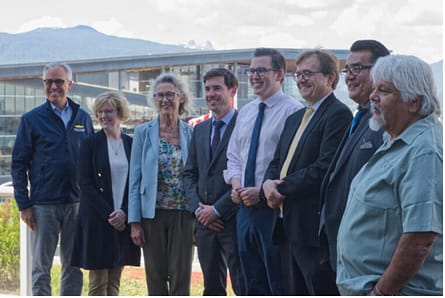
The Government of Canada announces transition from open net-pen salmon aquaculture in coastal British Columbia
News release
June 19, 2024
Ottawa, Ontario – Wild Pacific salmon are an emblematic species in British Columbia that face unprecedented threats to their survival. The Government of Canada is committed to protecting wild salmon and promoting more sustainable aquaculture practices.
Today, the Honourable Diane Lebouthillier, Minister of Fisheries, Oceans and the Canadian Coast Guard, announced that the Government of Canada will ban open net-pen salmon aquaculture in British Columbia coastal waters by June 30, 2029.
A number of First Nations, coastal communities, and others in British Columbia rely on open net-pen aquaculture for their livelihood and prosperity. The Government of Canada will release a draft salmon aquaculture transition plan by the end of July, that will focus on:
– how to support First Nations, workers, and communities in this transition;
– identifying economic supports for the use of innovative and clean aquaculture technology;
– milestones, principles, and criteria for the transition of salmon open net-pen aquaculture over the five-year licence period; and,
– management of salmon open net-pen aquaculture until the ban is fully implemented.
Over the coming months, federal departments, as part of a whole-of-government effort, will engage with those directly and indirectly affected by this transition to discuss how best to support them. This transition only applies to aquaculture practices in British Columbia, where Fisheries and Oceans Canada is the lead regulator for aquaculture. Elsewhere in Canada, where provinces and territories are the lead regulator, Fisheries and Oceans Canada respects their jurisdiction.
To facilitate a successful transition, Minister Lebouthillier also announced her intention to renew salmon aquaculture licences for five years. Effective July 1, 2024, these licences will come with stricter conditions to ensure improved management of sea lice on farmed fish, robust reporting requirements for industry, and additional monitoring of marine mammal interactions. These conditions will strengthen protections for wild species and the marine environment, while ensuring aquaculture facilities can operate safely during this transition period.
After July 1, 2024, only marine or land-based closed-containment systems will be considered for salmon aquaculture licences in coastal British Columbia. The Government of Canada recognizes that such systems are likely to come with increased investment costs. To provide greater predictability, Minister Lebouthillier also announced her intention to issue nine-year licences to successful closed-containment production applicants.
Over the past several years, the Department of Fisheries and Oceans heard a wide range of opinions, concerns, and views on open net-pen salmon aquaculture in coastal British Columbia. The Government of Canada is committed to ensuring a responsible, realistic, and achievable transition that will encourage innovative forms of aquaculture production for a more sustainable future.

PSF STATEMENT: Government of Canada outlines next steps in transition from open-net-pen salmon farming in British Columbia
June 22, 2022
Today, just before the vast majority of B.C. salmon farm licenses were set to expire, the Government of Canada has issued an update on their mandate to transition away from open-net pen salmon aquaculture in British Columbia.
The statement outlines work anticipated by Fisheries and Oceans Canada (DFO) over the course of the next year to develop the draft framework for transitioning away from open-net-pen salmon aquaculture by 2025.
The Pacific Salmon Foundation (PSF) has appreciated the opportunity to participate in and contribute to early phases of transition consultations with the Hon. Joyce Murray and DFO, and we look forward to further consultation to advance this mandate for the future health of wild Pacific salmon. Our team has been at the forefront of independent science related to the impacts open-net-pen fish farms have on wild Pacific salmon. The research (see links below) will continue.
The government’s announcement also clarified that the Minister will renew licenses for only two-years, in the case of marine finfish aquaculture facilities outside of the Discovery Islands – far shorter than the historical license renewal period.
PSF is encouraged by the two-year renewal as a strong signal from the Minister that the removal of salmon farms is nearing. We are also optimistic about the suggestion of tightened standards related to monitoring and sea lice management, as research has shown disease transfer between open-net fish farms and wild salmon as well as higher levels of sea lice near active farms. We will be scrutinizing DFO’s new licensing standards in the coming days.
The decision to not renew licences for Atlantic salmon facilities in the Discovery Islands, pending further consultations, is a win for some of our most at-risk wild salmon populations in B.C, including imperilled Fraser River sockeye.
Here at PSF, the Salmon Health team will continue working in partnership with DFO, First Nations and many other collaborators on vital research and monitoring related to the impacts of open-net-pen salmon farms on wild Pacific salmon. For more information on this research, visit here.
https://psf.ca/blog/psf-statement-government-of-canada-outlines-next-steps-in-transition-from-open-net-pen-salmon-farming-in-british-columbia/

Can DFO be trusted to implement the fish-farm ban?
Without being given legal force through legislation or regulations, the promised ban remains little more than another political promise vulnerable to ever-changing political winds.
Opinion | BY KAREN WRISTEN | July 1, 2024
Opinion Editorial by Karen Wristen published in the Hill Times
The majority of First Nations, commercial fishers, and concerned British Columbians heaved a sigh of relief when Fisheries Minister Diane Lebouthillier said Canada would “ban” open net-pen feedlots of Atlantic salmon in British Columbia. After fighting to protect wild salmon for thirty-years, we may have finally achieved something here. It may not happen as quickly as we’d like to see given the perilous state of wild salmon, but we must applaud the politicians who have taken this brave step, and we must acknowledge the support that workers will need during this transition.
But this initial relief comes with urgent, pressing, questions. How will the ban be given the force of law? And, more importantly, until then, how will endangered wild Pacific salmon be protected from the plume of pollution, parasites, and pathogens spewing from the open net-pen feedlots staining coastal British Columbia?
Without being given legal force through legislation or regulations, the promised ban remains little more than another political promise vulnerable to ever-changing political winds. Our praise for that promise is coupled with healthy skepticism: the same folks now promising a ban by 2029 previously promised a “transition from” open net-pen feedlots by 2025. With at least one federal election between now and 2029, it’s possible those now promising a ban will not be around when the ban is supposed to take effect.
A bigger mystery is how the Department of Fisheries and Oceans will protect wild salmon from polluting open net-pen feedlots for the next five years. The Minister also announced that licences will be issued for five years and promised “stricter” licence conditions and regulations, but provided no detail. Those licence conditions, and more importantly, their enforcement will fall to DFO.
It’s no secret that the public, and successive Ministers, have very different views than DFO bureaucrats on the harm open net-pen feedlots cause. DFO has consistently denied any connection between the pathogens and parasites flowing out of salmon farms and wild salmon health. For years, DFO has refused to incorporate conditions of licence that measure or address sources of harm despite repeated and insistent calls from conservation groups and First Nations to do so. DFO still allows the stocking of open net-pen feedlots with fish infected with piscine orthoreovirus (PRV) and has not reviewed the efficacy of its sea lice management measures…
Continue reading… As the Hill Times has a pay wall, read this article on Karen Wristen’s Living Oceans website:
 https://livingoceans.org/media/in-the-news/can-dfo-be-trusted-implement-the-fish-farm-ban
https://www.hilltimes.com/story/2024/07/01/can-dfo-be-trusted-to-implement-the-fish-farm-ban/426623/

Canada grants Mowi, Cermaq, Grieg long-term licenses for their BC hatchery facilities
The move opens up the possibility of expanding land-based operations to include full grow-out capabilities.
While salmon farmers in British Columbia must transition away from the use of netpen salmon farms by 2029, major operators in the area, including Mowi, Grieg and Cermaq, have received new nine-year licenses to operate land-based hatcheries.
Canada’s Department of Fisheries and Oceans (DFO) told IntraFish it has issued 51 licenses to existing land-based aquaculture facilities in British Columbia. The move would allow current farmers in the region to continue raising smolt and opens up the possibility of expanding their land-based operations to include full grow-out capabilities.
Note IntrFish has a paywall https://www.intrafish.com/aquaculture/canada-grants-mowi-cermaq-grieg-long-term-licenses-for-their-bc-hatchery-facilities/2-1-1692735
